
Amp-Hours to Watt-Hours (Ah to Wh) Calculator
Battery Energy Fundamentals
Battery energy conversion is essential for renewable energy systems, electric vehicles, portable electronics, and backup power applications. The conversion from amp-hours (Ah) to watt-hours (Wh) requires understanding the fundamental relationship between battery capacity, voltage, and stored energy.
Key Standards: Our calculator follows U.S. Energy Information Administration guidelines for electrical measurements and IEEE battery standards. The conversion accounts for battery chemistry variations and practical usage constraints.
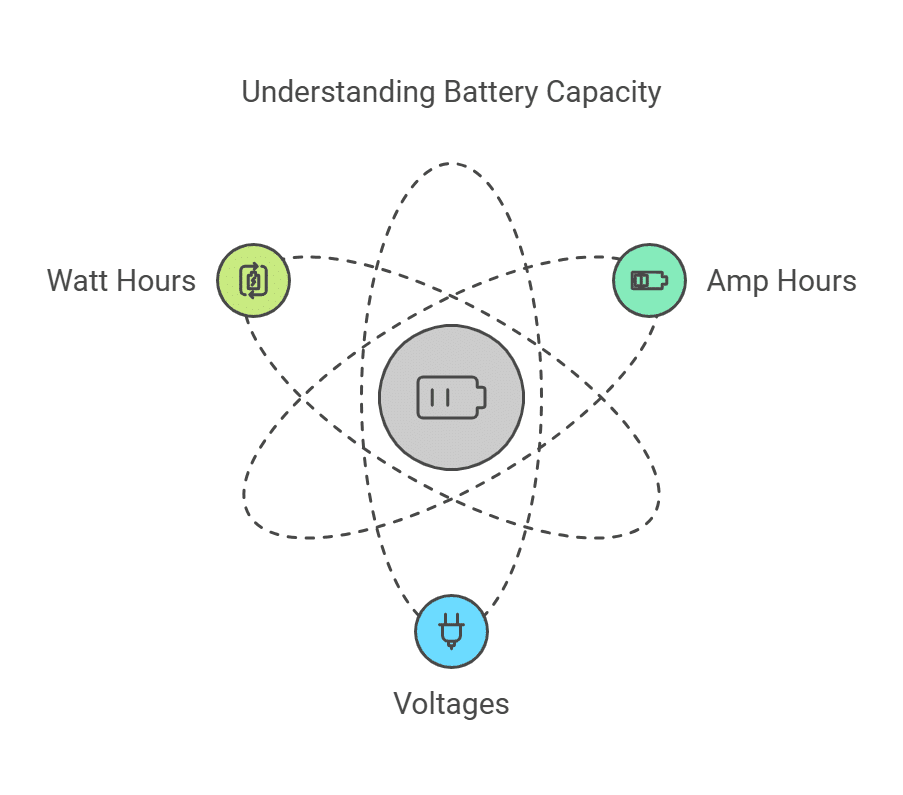
Amp-Hours (Ah) – Battery Capacity
Amp-hours (Ah) measure a battery’s electrical charge capacity – how much current a battery can deliver over time. One amp-hour means a battery can supply one ampere of current for one hour, or two amperes for half an hour, following the basic electrical principle that charge equals current multiplied by time.
Battery capacity in amp-hours determines how long a battery can power a device. Higher amp-hour ratings provide longer runtime, but actual performance depends on discharge rate, temperature, and battery age. Understanding amp-hours is crucial for sizing battery banks and predicting device runtime.
Watt-Hours (Wh) – Energy Storage
Watt-hours (Wh) measure the total energy a battery can store and deliver, combining both capacity (Ah) and voltage (V). This represents the actual work a battery can perform, making it the most important specification for comparing battery energy storage capabilities across different chemistries and voltages.
Watt-hours determine how much electrical work a battery can accomplish. For example, a 100 Wh battery can power a 10-watt device for 10 hours, or a 100-watt device for 1 hour. This measurement is essential for calculating battery runtime and comparing different battery technologies.
Battery Energy Calculation Formula
Ah = Battery capacity in amp-hours
V = Battery voltage in volts
Battery Chemistry & Voltage Guide
Different battery chemistries have characteristic voltage ranges that affect energy calculations. The table below shows typical voltage specifications for common battery types:
| Battery Chemistry | Nominal Voltage | Voltage Range | Typical Capacity | Applications |
|---|---|---|---|---|
| Lithium-Ion | 3.7V | 3.0V – 4.2V | 1,000 – 5,000 mAh | Smartphones, laptops, power tools |
| LiFePO4 | 3.2V | 2.5V – 3.65V | 5 – 100 Ah | Solar systems, electric vehicles |
| Lead-Acid | 2.0V per cell | 1.75V – 2.4V | 20 – 200 Ah | Car batteries, UPS systems |
| NiMH | 1.2V per cell | 1.0V – 1.4V | 800 – 3,000 mAh | Rechargeable batteries, cameras |
| Alkaline | 1.5V per cell | 1.6V – 0.8V | 500 – 2,000 mAh | Flashlights, remote controls |
Practical Examples
Calculation:
First, convert mAh to Ah: 3,000 mAh = 3.0 Ah
E(Wh) = 3.0 Ah × 3.7V = 11.1 Wh
Application: This battery can power a smartphone for 8-12 hours of typical use, or run a 1W device for over 11 hours. Understanding watt-hours helps compare battery life across different devices and manufacturers.
Calculation:
For a 400V system: 60,000 Wh ÷ 400V = 150 Ah
E(Wh) = 150 Ah × 400V = 60,000 Wh = 60 kWh
Application: This battery provides approximately 200-300 miles of driving range. Watt-hour calculations are essential for determining vehicle range and charging requirements.
Calculation:
E(Wh) = 200 Ah × 48V = 9,600 Wh = 9.6 kWh
Application: This battery bank can power essential home loads (lights, refrigerator, electronics) for 1-2 days during power outages. Large-scale energy storage requires accurate watt-hour calculations for system sizing.
⚠️ Battery Safety Disclaimer
This calculator provides theoretical calculations based on standard electrical engineering formulas for educational and planning purposes. Battery performance varies based on discharge rate, temperature, age, and specific battery characteristics. Always consult battery manufacturer specifications and follow safety guidelines when working with electrical energy storage systems. Improper battery use can result in fire, explosion, or personal injury. Professional installation and maintenance is recommended for all battery systems.


1 thought on “Amp Hours (Ah) To Watt Hours (Wh) Calculator”