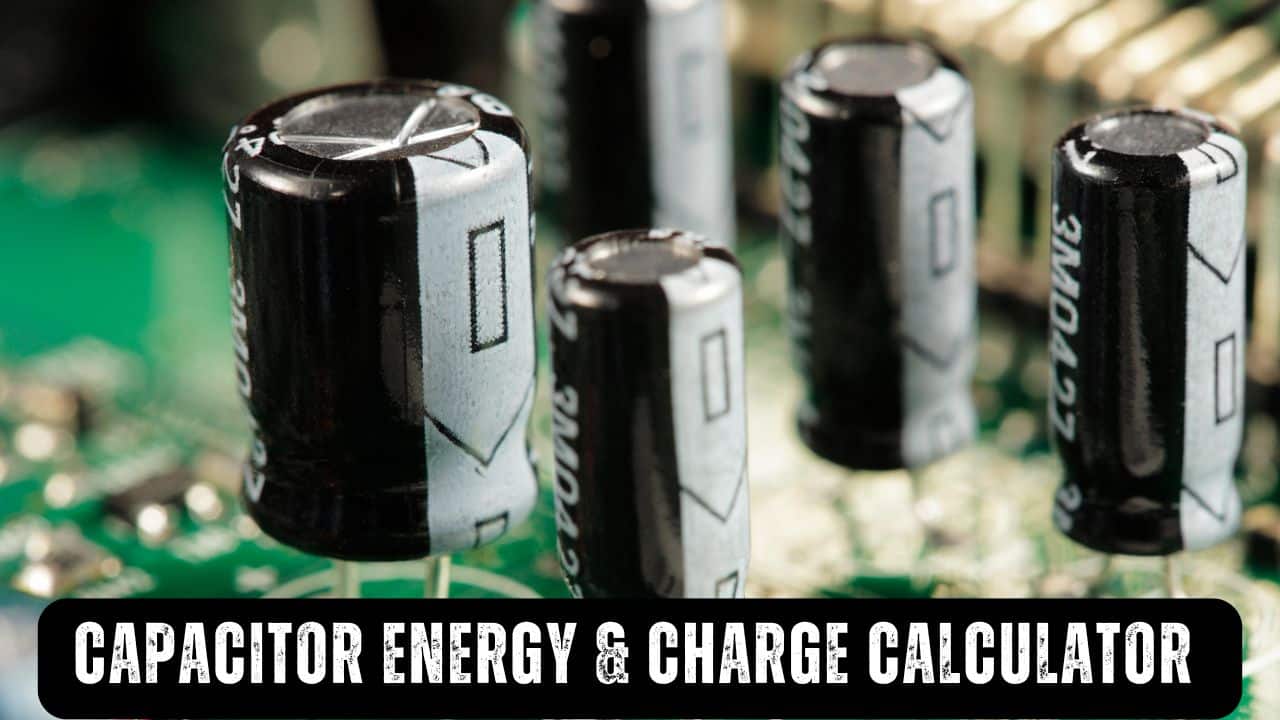
Capacitor Energy and Charge Calculator
Enter capacitance and voltage values to calculate the stored energy and charge. Select appropriate units for your calculations.
What is a Capacitor?
A capacitor is a fundamental electronic component that stores electrical energy in an electric field. It consists of two conductive plates separated by an insulating material called a dielectric. When voltage is applied across the plates, positive and negative charges accumulate, creating an electric field that stores energy. This stored energy can be released when needed, making capacitors essential for filtering, timing, energy storage, and signal processing applications.
Capacitance, measured in farads (F), determines how much charge a capacitor can store per volt of applied voltage. The ability to store and release electrical energy quickly makes capacitors crucial in modern electronics, from smartphone circuits to large-scale power systems.
Capacitor Energy Storage Principles
The energy stored in a capacitor depends on both its capacitance and the square of the applied voltage. This quadratic relationship means that doubling the voltage quadruples the stored energy, making voltage management critical in capacitor applications. The ability to store energy without continuous power input makes capacitors invaluable for applications requiring quick energy bursts. For energy unit conversions between joules and kilojoules, use our Joules to Kilojoules Calculator.
Understanding capacitor charge and energy relationships is essential for designing reliable electronic circuits. Whether you’re working with timing circuits, power supplies, or energy storage systems, accurate calculations ensure optimal performance and safety.
Capacitor Formulas and Theory
C = Capacitance in farads (F)
V = Voltage in volts (V)
C = Capacitance in farads (F)
V = Voltage in volts (V)
Q = Charge in coulombs (C)
V = Voltage in volts (V)
Q = Charge in coulombs (C)
V = Voltage in volts (V)
Q = Charge in coulombs (C)
C = Capacitance in farads (F)
ε₀ = Vacuum permittivity (8.85×10⁻¹² F/m)
εᵣ = Relative permittivity (dielectric constant)
A = Plate area in square meters (m²)
d = Plate separation in meters (m)
Capacitor Types and Applications
| Type | Typical Range | Voltage Rating | Key Characteristics | Applications |
|---|---|---|---|---|
| Ceramic | 1pF – 100µF | 16V – 10kV | Low cost, stable, low ESR | Coupling, decoupling, timing circuits |
| Electrolytic | 1µF – 1F | 6.3V – 500V | High capacitance, polarized | Power supplies, filtering |
| Tantalum | 100nF – 1mF | 4V – 50V | Stable, low ESR, small size | Military, aerospace, precision circuits |
| Film | 100pF – 100µF | 50V – 2kV | High voltage, low distortion | Audio equipment, motor run capacitors |
| Supercapacitor | 0.1F – 5kF | 2.5V – 5.5V | High energy density, fast charge/discharge | Energy storage, backup power |
| Mica | 1pF – 10nF | 100V – 2kV | High precision, stable | RF circuits, precision timing |
Calculation:
Individual capacitor: 10µF at 5V
Energy per capacitor: E = ½ × 10×10⁻⁶ × 5² = 0.000125 J = 125 µJ
Five capacitors in parallel: Total C = 50µF
Total energy: E = ½ × 50×10⁻⁶ × 5² = 0.000625 J = 625 µJ
Application: These capacitors smooth voltage fluctuations, ensuring stable operation of the processor and display. The energy storage helps maintain voltage during brief power interruptions.
Calculation:
Capacitor bank: 10,000µF at 16V (safe operating voltage)
Stored charge: Q = 10×10⁻³ × 16 = 0.16 C = 160,000 µC
Stored energy: E = ½ × 10×10⁻³ × 16² = 1.28 J
Energy in watt-hours: 1.28 ÷ 3600 ≈ 0.000356 Wh
Application: These capacitors provide surge current capability and voltage stabilization during load changes. The energy storage helps ride through brief power line disturbances. For power factor and volt-ampere calculations, use our Watts to Volt-Amperes Calculator.
Calculation:
Capacitor: 1F at 16V (automotive voltage)
Stored charge: Q = 1 × 16 = 16 C
Stored energy: E = ½ × 1 × 16² = 128 J
Energy in watt-hours: 128 ÷ 3600 ≈ 0.0356 Wh
Application: This large capacitor acts as an energy reservoir, providing instant current for bass notes and reducing voltage sag during high-demand musical passages. For automotive power and torque calculations, use our Torque Calculator.
⚠️ Electrical Safety Disclaimer
This calculator provides theoretical calculations for educational and design purposes. Working with capacitors involves electrical hazards including shock, fire, and explosion risks. Always discharge capacitors before handling, use appropriate voltage ratings, and follow electrical safety standards. Calculations should be verified by qualified electrical engineers for critical applications.