
Elastic Potential Energy
Master the fundamentals of elastic energy, spring mechanics, and energy storage in deformable materials!
What is Elastic Potential Energy and Why Does it Matter?
Elastic Potential Energy is the mechanical potential energy stored in the configuration of a material or physical system when it is subjected to elastic deformation. Understanding elastic energy principles is fundamental to mechanical engineering, materials science, and physics applications involving springs, elastic materials, and energy storage systems.
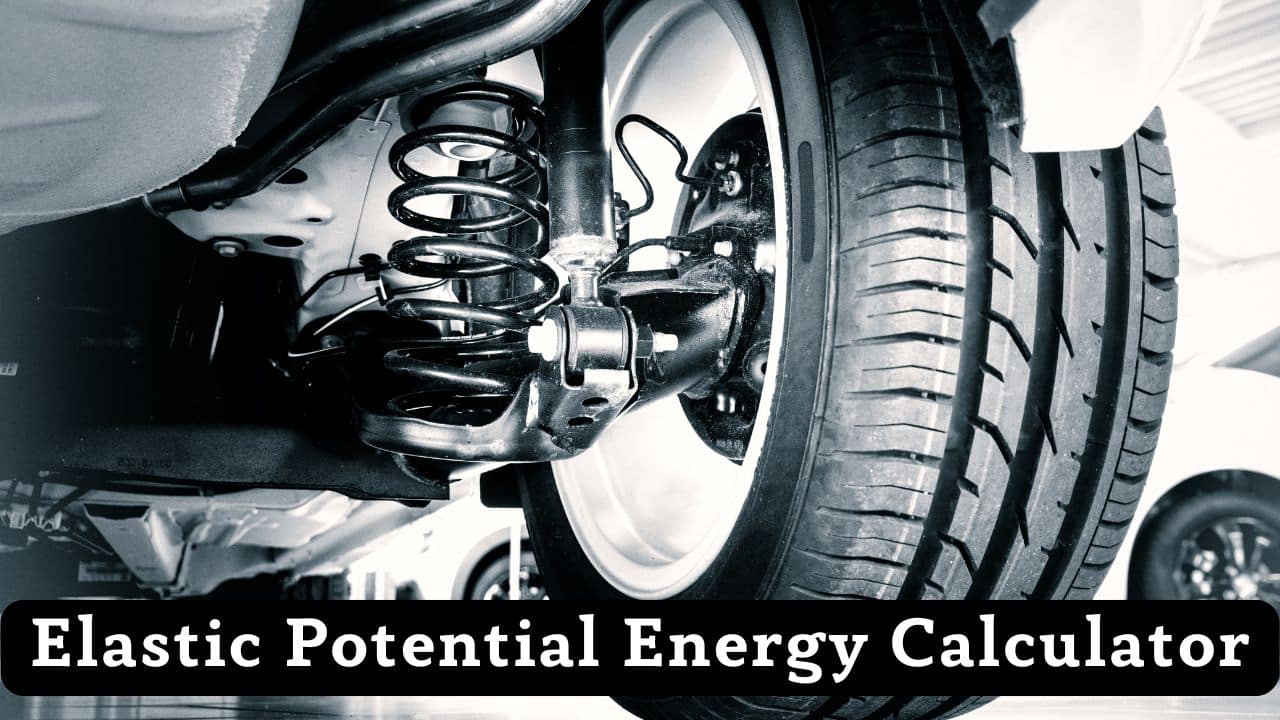
Why elastic energy matters: Elastic potential energy is crucial for understanding how energy is stored and released in mechanical systems. From car suspensions to building foundations, elastic energy governs how structures respond to forces and return to their original shape.
Key Elastic Energy Concepts:
- Hooke’s Law: F = kx (force proportional to displacement)
- Elastic Limit: Maximum deformation before permanent damage
- Spring Constant: Measure of spring stiffness (k)
- Energy Conservation: Elastic energy converts to kinetic energy
- Simple Harmonic Motion: Oscillatory behavior of elastic systems
- Stress-Strain Relationship: Material response to applied forces
Fundamental Formulas and Relationships
The fundamental elastic potential energy equation U = ½kx² shows that energy increases quadratically with displacement. This relationship is central to understanding spring behavior and energy storage in elastic systems.
Common Spring Constants by Application:
| Application | Typical k Range (N/m) | Material | Energy Storage | Common Uses |
|---|---|---|---|---|
| Watch Springs | 0.1 – 10 | Steel alloy | Very low | Timekeeping, precision |
| Pen Springs | 10 – 100 | Steel | Low | Writing instruments |
| Car Suspension | 10,000 – 50,000 | Steel coil | High | Vehicle comfort, handling |
| Building Dampers | 100,000 – 1,000,000 | Steel/composite | Very high | Earthquake protection |
| Industrial Presses | 1,000,000 – 10,000,000 | High-strength steel | Extreme | Manufacturing, forming |
| Rubber Bands | 1 – 1,000 | Natural/synthetic rubber | Variable | General purpose, toys |
Practice Problems and Worked Solutions
Problem 1: Basic Elastic Potential Energy
Question: Calculate the elastic potential energy stored in a spring with k = 200 N/m when compressed by 0.15 m.
Click to see detailed solution
Given: k = 200 N/m, x = 0.15 m
Formula: U = ½kx²
Calculation: U = ½ × 200 × (0.15)² = ½ × 200 × 0.0225 = 2.25 J
Answer: The elastic potential energy is 2.25 J
Physical meaning: This energy could lift a 0.23 kg mass to a height of 1 meter
Problem 2: Spring Constant Determination
Question: A spring stores 50 J of energy when compressed by 0.2 m. Find the spring constant.
Click to see detailed solution
Given: U = 50 J, x = 0.2 m
Formula: U = ½kx², therefore k = 2U/x²
Calculation: k = 2 × 50 / (0.2)² = 100 / 0.04 = 2,500 N/m
Answer: The spring constant is 2,500 N/m
Application: This is typical for medium-duty automotive springs
Problem 3: Energy Conservation in Springs
Question: A 2 kg mass attached to a spring (k = 800 N/m) is displaced 0.1 m and released. Find the maximum velocity.
Click to see detailed solution
Given: m = 2 kg, k = 800 N/m, x = 0.1 m
Energy Conservation: U_elastic = K_kinetic at equilibrium
Elastic Energy: U = ½kx² = ½ × 800 × (0.1)² = 4 J
Kinetic Energy: K = ½mv² = 4 J
Solving for v: v = √(2K/m) = √(8/2) = 2 m/s
Answer: Maximum velocity is 2 m/s at the equilibrium position
