
⚛️ Joule to Kilogram Converter
Convert energy to mass using Einstein’s mass-energy equivalence (E=mc²)
- Mass-Energy Equivalence
- The Conversion Formula Explained
- Step-by-Step Calculation Example
- Real-World Applications of E=mc²
- Where Mass-Energy Equivalence Matters
- Energy to Mass Conversion Reference
- Why Can’t We Convert Mass to Energy Easily?
- The Challenge of Mass-Energy Conversion
- Related Energy Conversion Tools
- Author
Mass-Energy Equivalence
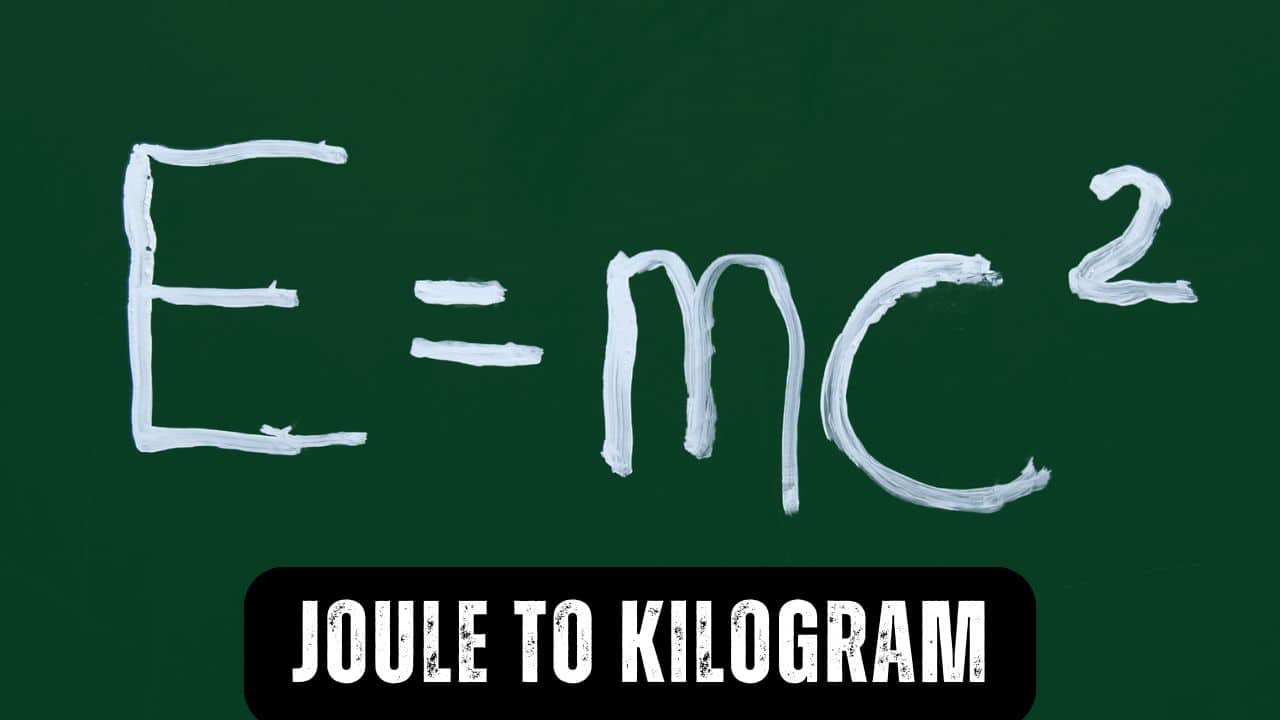
Joules measure energy, while kilograms measure mass—two fundamentally different physical quantities. They cannot be directly converted with a simple factor like inches to centimeters. However, Einstein’s famous equation E=mc² establishes a profound relationship between energy and mass.
To find mass from energy, we rearrange the equation: m = E / c². This tells us that mass equals energy divided by the square of the speed of light. Since c² is approximately 9 × 10¹⁶ m²/s², a tremendous amount of energy corresponds to a tiny amount of mass.
The Conversion Formula Explained
The precise value of the speed of light in vacuum is defined as exactly 299,792,458 meters per second. When we square this value, we get the conversion factor between energy and mass.
Step-by-Step Calculation Example
Formula: m = E / c²
Speed of light: c = 299,792,458 m/s
c² = 8.98755178736 × 10¹⁶ m²/s²
Calculation:
m = 100 J / (8.98755178736 × 10¹⁶ m²/s²)
m = 1.112650056 × 10⁻¹⁵ kg
m ≈ 1.113 femtograms
As you can see, 100 joules corresponds to about 1.113 femtograms (10⁻¹⁵ kg)—an incredibly tiny mass! This demonstrates why we don’t notice mass changes in everyday energy transformations.
Real-World Applications of E=mc²
While the mass equivalence of everyday energies is minuscule, this relationship becomes critically important in nuclear physics, particle physics, and cosmology.
Where Mass-Energy Equivalence Matters
Energy to Mass Conversion Reference
This table shows the mass equivalent of various energy amounts, demonstrating why mass-energy conversion is only observable in extreme conditions.
| Energy (Joules) | Equivalent Mass | Context |
|---|---|---|
| 1 J | 1.113 × 10⁻¹⁷ kg (11.13 ag) | Energy to lift an apple 1 meter |
| 1 kJ | 1.113 × 10⁻¹⁴ kg (11.13 fg) | Food calorie (≈0.24 kJ) |
| 1 MJ | 1.113 × 10⁻¹¹ kg (11.13 pg) | Energy in AAA battery |
| 1 GJ | 1.113 × 10⁻⁸ kg (11.13 ng) | Lightning strike energy |
| 3.6 × 10¹⁵ J | 40 g | One megaton nuclear explosion |
| 9 × 10¹⁶ J | 1 kg | Complete conversion of 1 kg |
| 3.8 × 10²⁶ J | 4.2 million tons | Sun’s energy output per second |
Why Can’t We Convert Mass to Energy Easily?
If E=mc² tells us that mass contains enormous energy, why don’t we just convert everyday objects to power our homes? The answer lies in the fundamental forces of nature.
The Challenge of Mass-Energy Conversion
Despite these challenges, nuclear power plants successfully convert tiny amounts of mass to energy using controlled fission reactions, providing clean baseload electricity for millions of people worldwide.
Related Energy Conversion Tools
Explore our comprehensive collection of energy and mass conversion calculators:
