
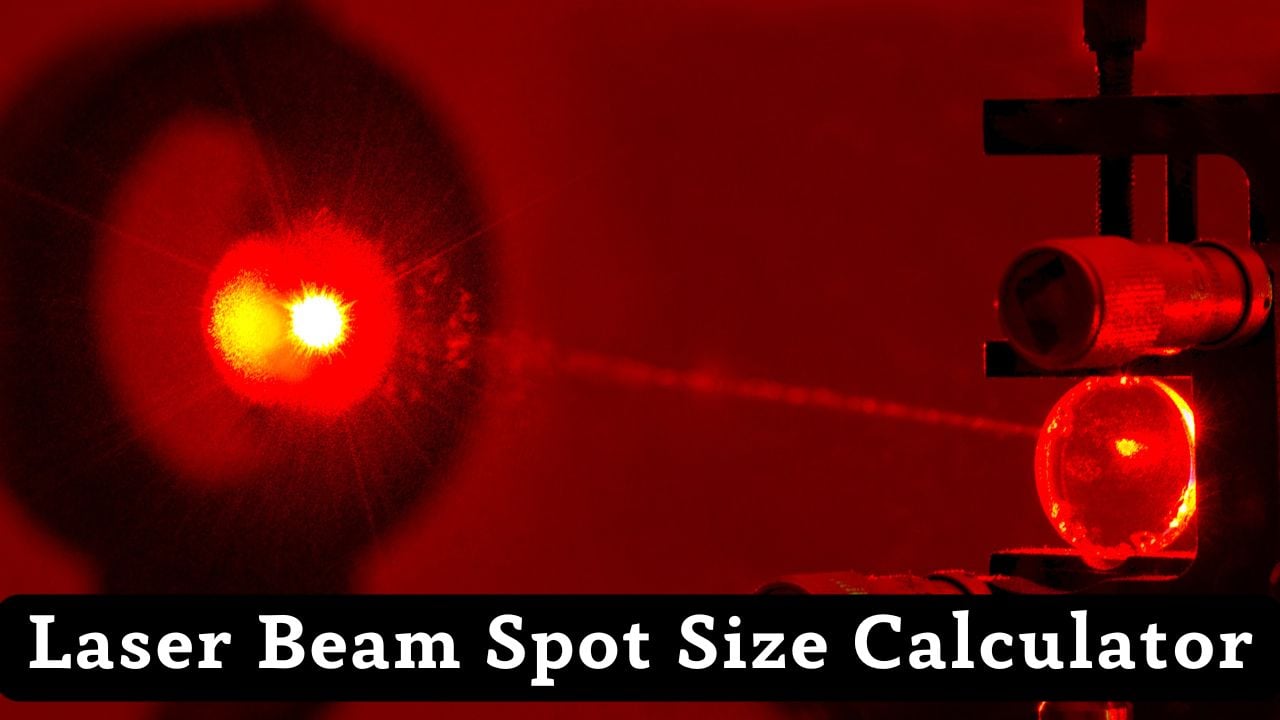
What is Laser Beam Spot Size
Laser beam spot size is a fundamental concept in laser optics that determines how tightly you can focus a laser beam and how it propagates through space. Understanding spot size calculations is essential for laser processing, optical communications, scientific research, and countless industrial applications.
Why Laser Spot Size Matters:
- Laser Processing: Determines cutting precision, welding quality, and material processing capabilities
- Optical Communications: Affects signal coupling efficiency and transmission quality
- Scientific Research: Critical for microscopy, spectroscopy, and precision measurements
- Medical Applications: Controls treatment precision in laser surgery and therapy
- Industrial Manufacturing: Enables precise marking, engraving, and 3D printing
- Defense Systems: Determines range and effectiveness of laser-based systems
The Physics of Gaussian Laser Beams
Most laser beams follow a Gaussian intensity profile, meaning the light intensity is highest at the center and decreases exponentially toward the edges. This natural beam shape emerges from the fundamental physics of laser oscillation and provides the most efficient way to focus light to a small spot.
Key Gaussian Beam Properties:
- Beam Waist (w₀): The smallest radius where the beam is focused
- 1/e² Definition: Spot size is measured where intensity drops to 13.5% of peak
- Rayleigh Range (z_R): Distance over which beam area doubles
- Divergence Angle (θ): How quickly the beam expands with distance
- M² Factor: Measures how close a real beam is to ideal Gaussian
The fundamental relationship governing all Gaussian beams is the diffraction limit: as you make the beam waist smaller, the divergence angle increases. This trade-off between spot size and beam quality is a fundamental law of physics that cannot be violated – only optimized for specific applications.
Essential Spot Size Calculations and Formulas
Different situations require different calculation approaches. Understanding when and how to use each formula is crucial for successful laser system design.
Diffraction-Limited Focusing: w = λf/πw₀
Application: Ideal focusing with perfect optics and TEM₀₀ laser mode
Key Insight: Smallest possible spot size for given wavelength and optics
Variables: λ (wavelength), f (focal length), w₀ (input beam waist)
Example: 632nm HeNe laser with 50mm lens and 1mm beam waist gives 10.1μm spot
Real Beam with M² Factor: w = M²λf/πw₀
Application: Practical calculations with real laser beams
Key Insight: M² factor accounts for beam quality degradation
Typical Values: M² = 1.1 (excellent), 1.5 (good), 2+ (multimode)
Reality Check: Most diode lasers have M² = 1.3-2.0
Collimated Beam Focusing: w = λf/π(D/2)
Application: Focusing a parallel beam through a lens
Key Insight: Larger input beams create smaller focused spots
Practical Tip: Often used with beam expanders for smallest spots
f-number: Lower f/# (shorter focal length) gives smaller spots
The M² Factor: Understanding Real Laser Beam Quality
The M² (M-squared) factor is perhaps the most important parameter for characterizing real laser beams. While textbooks often assume perfect Gaussian beams, real lasers deviate from this ideal, and M² quantifies exactly how much.
M² Factor Interpretation:
- M² = 1.0: Perfect TEM₀₀ Gaussian beam (theoretical ideal)
- M² = 1.1-1.3: Excellent quality (single-mode fiber lasers, quality diodes)
- M² = 1.3-1.8: Good quality (standard laser diodes, some solid-state)
- M² = 1.8-2.5: Fair quality (multimode diodes, some DPSS lasers)
- M² > 2.5: Poor quality (broad-area diodes, multimode fiber)
Physical Meaning: An M² = 2 beam will have 2× larger spot size and 2× larger divergence than a perfect Gaussian beam with the same power and waist size. This directly impacts applications requiring tight focusing.
Rayleigh Range and Beam Propagation
The Rayleigh range (z_R = πw₀²/λ) tells you how far a focused beam stays “small” before diverging significantly. This parameter is crucial for applications requiring extended interaction lengths.
Practical Implications of Rayleigh Range:
- Laser Cutting: Determines maximum material thickness for clean cuts
- Laser Welding: Controls penetration depth and weld profile
- Optical Trapping: Sets the axial extent of the trapping region
- Microscopy: Defines the depth of field for laser scanning
- Material Processing: Balances spot size with interaction length
Design Trade-off: Smaller spots have shorter Rayleigh ranges. A 1μm spot at 1μm wavelength has a Rayleigh range of only 3.1μm, while a 10μm spot extends to 314μm. Choose your spot size based on required working distance.
Wavelength Effects and Optimization
Wavelength choice profoundly affects achievable spot sizes and beam propagation characteristics. Understanding these relationships helps optimize laser systems for specific applications.
Wavelength Scaling Rules:
- Spot Size: Proportional to wavelength – shorter wavelengths focus tighter
- Divergence: Longer wavelengths diverge faster for same waist size
- Rayleigh Range: Inversely proportional to wavelength
- Diffraction Limit: UV lasers can achieve submicron spots
- Material Interaction: Wavelength affects absorption and processing
Common Laser Wavelengths and Applications:
- 355nm (UV): Precision micromachining, submicron spots possible
- 532nm (Green): Scientific applications, good balance of spot size and power
- 632.8nm (HeNe): Alignment and metrology, excellent beam quality
- 808nm, 980nm (NIR): Diode pumping, fiber coupling, medical applications
- 1064nm (Nd:YAG): Industrial processing, good power scaling
- 10.6μm (CO₂): Material processing, larger spots but high power
