
Volts to Ohms Calculator
Convert voltage (Volts) to resistance (Ohms) using Ohm’s Law. Calculate R = V ÷ I with instant results.
- How to Convert Volts to Ohms
- The Ohm’s Law Formula for Resistance
- Step-by-Step Example
- Volts to Ohms Conversion Table
- Understanding Ohm’s Law Triangle
- Calculating Resistor Value for LED Circuits
- Standard Resistor Values (E24 Series)
- Practical Tips for Resistor Selection
- Power Dissipation in Resistors
- Frequently Asked Questions
- Author
How to Convert Volts to Ohms
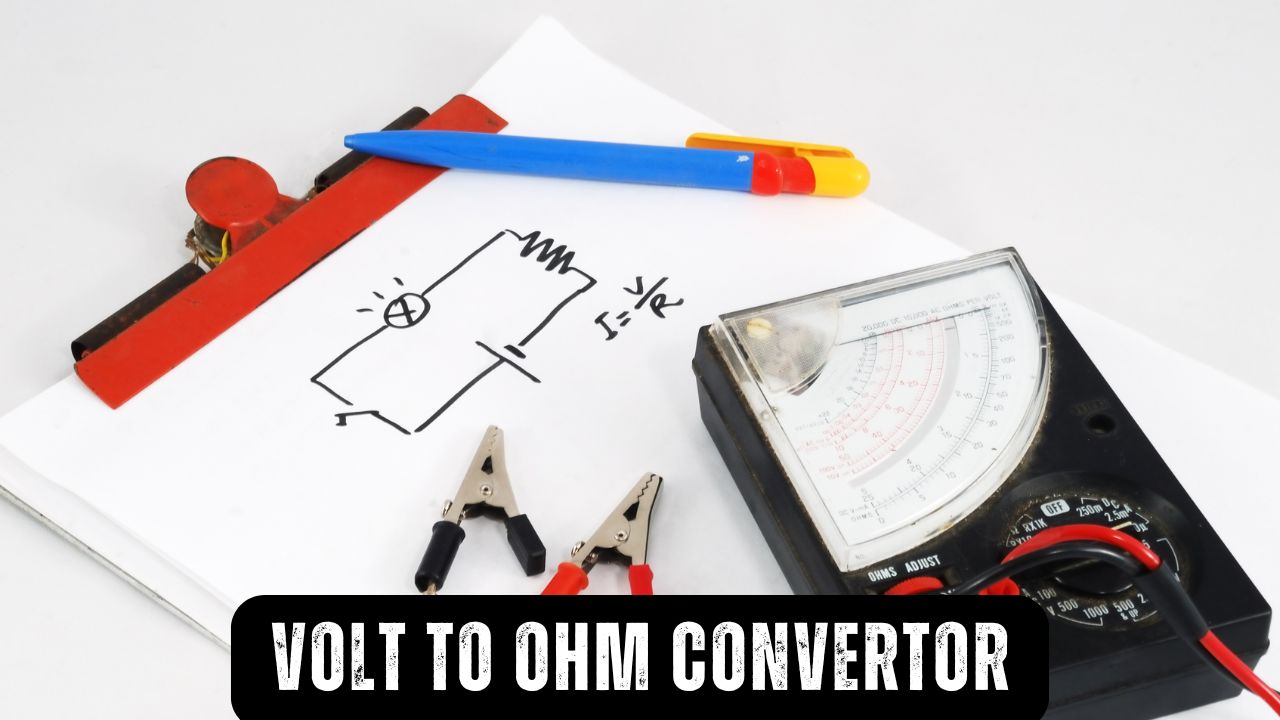
Converting Volts to Ohms requires understanding Ohm’s Law, one of the most fundamental principles in electrical engineering. While Volts measure electrical potential and Ohms measure resistance, these units are connected through current flow.
This calculator helps you find resistance when you know the voltage and current in your circuit. Whether you’re selecting resistors for LED circuits, designing voltage dividers, or troubleshooting electronics, this tool provides accurate calculations with step-by-step explanations.
The Ohm’s Law Formula for Resistance
This formula tells us that resistance equals voltage divided by current. If you have 12 volts across a component with 0.1 amperes flowing through it, the resistance is 120 ohms.
Step-by-Step Example
Problem: You need to limit current to 20 milliamperes (mA) in a 5V circuit for an LED. What resistor value do you need?
Step 1: Convert milliamperes to amperes
20 mA = 20 ÷ 1000 = 0.02 A
Step 2: Apply Ohm’s Law (rearranged for resistance)
R = V ÷ I = 5 V ÷ 0.02 A = 250 Ω
Answer: You need a 250-ohm resistor. The nearest standard value is 270Ω (E24 series), which would give you approximately 18.5mA – still safe for most LEDs.
Volts to Ohms Conversion Table
| Voltage (V) | Current (A) | Resistance (Ω) | Common Application |
|---|---|---|---|
| 5 V | 0.5 A | 10 Ω | USB Load Resistor |
| 12 V | 0.1 A | 120 Ω | Automotive LED Circuit |
| 3.3 V | 0.02 A | 165 Ω | Microcontroller LED |
| 9 V | 0.02 A | 450 Ω | Battery-Powered LED |
| 24 V | 0.05 A | 480 Ω | Industrial Indicator |
| 120 V | 1 A | 120 Ω | Household Appliance |
| 5 V | 0.001 A | 5,000 Ω (5 kΩ) | Pull-up Resistor |
Understanding Ohm’s Law Triangle
Ohm’s Law can be rearranged to solve for any of the three variables. The “Ohm’s Law Triangle” is a helpful memory tool:
According to Wikipedia’s article on Ohm’s Law, this relationship was discovered by Georg Simon Ohm in 1827 and remains one of the most important equations in electrical engineering.
Calculating Resistor Value for LED Circuits
One of the most common uses for the Volts to Ohms conversion is calculating current-limiting resistors for LEDs. The formula is:
For example, with a 12V supply, a red LED (2V forward voltage), and 20mA current: R = (12 – 2) ÷ 0.02 = 500Ω. Use a standard 470Ω or 510Ω resistor.
For more LED calculations, try our Ohms to Watts Calculator to ensure your resistor won’t overheat.
Standard Resistor Values (E24 Series)
| Decade | Available Values | Common Uses |
|---|---|---|
| 1Ω – 9.1Ω | 1.0, 1.1, 1.2, 1.3, 1.5, 1.6, 1.8, 2.0, 2.2, 2.4, 2.7, 3.0, 3.3, 3.6, 3.9, 4.3, 4.7, 5.1, 5.6, 6.2, 6.8, 7.5, 8.2, 9.1 | Current sensing |
| 10Ω – 91Ω | Same values × 10 | Power circuits |
| 100Ω – 910Ω | Same values × 100 | LED limiting |
| 1kΩ – 9.1kΩ | Same values × 1000 | Signal conditioning |
| 10kΩ – 91kΩ | Same values × 10000 | Pull-up/down resistors |
Practical Tips for Resistor Selection
1. Use the nearest standard value: After calculating, choose the nearest E24 series value. Our calculator suggests this automatically.
2. Check power dissipation: Calculate P = V × I or P = V² ÷ R to ensure your resistor can handle the heat. Use a resistor rated at least 2× the calculated power.
3. Consider tolerance: A 5% tolerance 100Ω resistor could be 95Ω to 105Ω. For precision circuits, use 1% tolerance resistors.
Need to calculate current? Use our Volt to Amps Calculator to find current when you know voltage and resistance.
Power Dissipation in Resistors
When current flows through a resistor, it dissipates power as heat. You can calculate this using:
This is crucial for selecting the right resistor wattage rating. Common ratings are 1/4W, 1/2W, 1W, 2W, and 5W. For reliable circuits, use resistors rated at least twice the calculated power dissipation.
For comprehensive electrical calculations including power factor, check our Amp Volt Watt Calculator.